The global pandemic has decimated many industries worldwide. Hospitality, entertainment, sports, and retail have all suffered enormously from reduced customer numbers and government restrictions. But several businesses have escaped unscathed, and in some cases, even thrived throughout this difficult time. The e-commerce industry has benefited from the increase in online shopping, and the need to entertain ourselves at home has provided a lot of business for the streaming giants.
If you are considering starting your own business from home in 2021, you need to be sure that it can survive these turbulent times. It’s harder than ever to get a business off the ground, and uncertainty about the future makes it even more of a challenge. It will require a lot of hard work and motivation to make your dream a reality.
If you are determined to launch your home business, here are four tips to help you succeed.
Make a business plan
If you don’t have a business plan, you will find it very difficult to succeed. This plan is essentially a roadmap for success, outlining your specific business goals and the strategies you will employ to reach them. This will enable you to keep track of your progress and analyze how well your business is performing at any one time. It will provide extra motivation to work hard and achieve results, as well as informing all your decisions and guiding you on the best actions to take.
Create your workspace
When you are working from home, you will need a dedicated workspace in which to carry out your day-to-day tasks. With the freedom that comes from home-working, it might be tempting to sometimes work from your bed or sprawled on the sofa, but this won't get you in the business mindset. Whether you have your own office or are just using the dining room table, an organized, fully-equipped workspace will make it easier to get things done. Fill it with all the technology and stationery you require and make yourself more comfortable with an ergonomic desk chair.
Have a schedule
When you run your own business, no one is forcing you to start working at 9 am and clock out at 5. You have the freedom to manage your workload according to your own schedule. But what’s important is not letting your work and personal life blur into one. When your office and your home are the same place, you can end up working well into the early hours and not giving yourself a break. It’s important you create a work schedule. This doesn't have to be the same every day, but it should provide clear guidance for when to close the laptop and give yourself a break.
Grow your network
Getting ahead in business is all about how you know, and when you’re working from home, it’s hard to grow your network. Make an effort to meet people, whether through conferences, trade events, or asking people to introduce you to their contacts. The more people you know, the more likely you’ll be to find new opportunities and customers.
Whether you’re a social media fan or roll your eyes at the mention of Facebook or Twitter, all businesses and entrepreneurs can benefit from having a presence on these platforms. When you factor in the number of social media users, which is in the billions, it makes complete sense to use the tool for marketing your brand.
While some business owners have a good grasp on social media already, others aren’t sure how to get the most out of it. To help, here are some tips that will make you a social media pro in no time.
Begin with a Plan
Before you dive into the social media world, you need to have a plan in place on what you want to achieve. Conducting a social media audit, creating goals that follow the SMART framework, and looking into what competitors do will give you inspiration on how to conduct yourself on social media. If you need help coming up with a social media strategy, companies like JBD Agency can help. You should also create a social media calendar that adds structure and ensures you’re posting the right content to your pages at the right time.
Choose the Right Platforms
You may not realize it, but the social media platform you use for business purposes can have a huge impact on your revenue. For example, if you want to target Gen Z, many of them use platforms like Snapchat and TikTok. If you want to appeal to millennials and generation X, you’re likely to find them on Facebook. There are pros and cons to all social media platforms, so you need to decide which platform will benefit you the most.
Know Your Target Audience
If you don’t have your target audience established, you’ll have great difficulty maintaining a social media presence. For instance, if your products or services appeal to stay-at-home moms, you should post content and updates during the morning and afternoon where they are more likely to see them. Make sure you begin with your current customers and start compiling data, before digging deeper into social media analytics. As you do more research, you will get a better idea of who is visiting your pages and buying into your brand.
Focus on Quality
Many business owners make the mistake of focusing on quantity, rather than quantity on social media. While you may believe posting constant updates will benefit your brand, users don’t want their feed to be completely filled with your output. Instead, you should focus on creating quality content that is short and sweet and gets the message across. Once a consumer subscribes to your page, try not to lose their custom by spamming them.
Stay Consistent
Building and maintaining a successful social media business page takes time and effort. As your page grows in popularity, you need to remain consistent, otherwise users may not have faith and trust in your brand. It may be wise to have a social media team designated to keeping your pages updated, but only if you can afford to do so.
If you know how to use social media to your advantage, your business will benefit enormously. Creating business pages on platforms like Facebook can be a fantastic way to build your audience, keep connected with customers, and create a reputable brand.
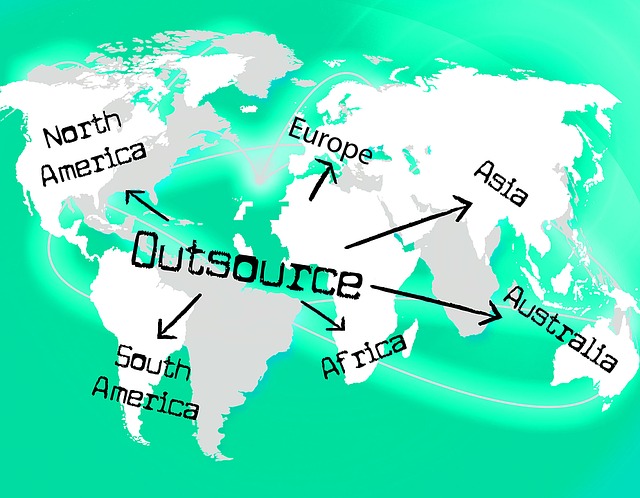
Outsourcing has numerous advantages for businesses that embrace it. It involves contracting outside parties for various practices instead of assigning tasks to other staff or hiring new employees. In the long run, a business becomes successful because it can save on operational costs as it streamlines operations and focuses on more important functions. Some of the reasons why it is a key ingredient for business success are:
As your business grows, there is an increase in functions. Some are core, while others are not. More focus on non-core functions when there is additional workload causes the business to suffer. By outsourcing non-core functions in such a scenario, employees focus on core functions to give quality output while third parties deal with the primary tasks.
Controls and lowers operational costs
In departments where costs rise over time, outsourcing ensures there are better management and control over costs. For example, you can have managed IT services through outsourcing, which ensures that you stay under budget when there are many projects and not enough personnel.
Outsourcing reduces the need to purchase new equipment and look for new locations when in need of more office space due to an increase in the number of employees. In comparison to the cost of hiring more personnel, expanding the office space, or relocating, outsourcing is by far the less expensive option.
Increases internal efficiency
Outsourcing allows you to make efficient use of internal staff when a third party shares their workload. Where you have large projects in a business, they may require skills that your employees do not have. Bringing in new contractors in your location to work beside your staff, your employees can gain new skill sets by learning from them.
Provides better risk management
Through outsourcing, you share any risks that may occur with your third-party partners. This way, you can reduce your burden. For example, outsourcing to a competent partner will reduce the risk of having the same task done by an employee who is not skilled in that area. When there are high levels of inconsistency and uncertainty, outsourcing provides continuity, thereby contributing to business success.
Promotes growth and business continuity
Outsourcing gives you the advantage of running your business 24/7, especially if it is online. Even when your employees go home after their 9 am to 5 pm shift, your outsourcing partners can keep working. Where there are critical and urgent tasks, they are available to perform and send them for review as soon as possible. With outsourcing, there will be hardly any concerns or absenteeism that will cause inconveniences, hence promoting continuity.
Where some overhead costs are very high but performing them will promote more customer satisfaction, outsourcing is an excellent option to evade high costs and inefficiencies.
Bottom line
If you're looking to grow your business, you can outsource for business success. Outsourcing has benefits such as promoting growth and continuity, providing better risk management, improving focus on core activities, increasing internal efficiency, and lower operational costs.
Paid Media experts often reevaluate and experiment with ways to optimize processes and get the most results. After all, the world of Facebook Ads can be daunting, and you certainly don’t want to follow in the footsteps of one man who lost 600k in 4 days on his Facebook Ads. Ouch, that hits us where it hurts.
Even if you’re not an expert, there are probably (definitely) a few things you could do right now to save money on your Facebook Ads. And if you’re a human being, that is something you should want. Let’s take a look at some you can correct today:
You’re picking the wrong campaign objective
Although this may seem obvious, you’d be surprised how often this crucial element gets overlooked when launching an ad campaign. Facebook Ads campaigns break down into three main objectives, each with their own sub-objectives.
Before you get to this stage, you should have already identified your Facebook Ad’s purpose and the results you want to see. (If not, we suggest doing that now). The objective you select should fit into your overall business strategy and serve as a shorter-term tactic to achieve long term goals. Once you know your objectives, it makes writing your ad easier, since you’ve determined who and what you’re writing for.
Source: Business2Community
The three campaign types are:
Awareness: this objective is for those at the top level of your marketing funnel, who may not even know you exist. It’s also commonly used by larger brands when they have new products services.
Ad objectives for Awareness are:
Brand awareness: letting people know who you are. Where you are or what you do.
Reach: casting as wide of a net as possible, and having the most eyes viewing your ad.
Consideration: this objective would be for those in the middle of the marketing funnel, who may know you exist but need to have more information before converting into a customer. You want to guide your potential buyer to want to take action, whether through education, information, or entertainment.
Ad objectives for Consideration are:
Traffic: sending users from Facebook to a designated URL such as a landing page or official website.
Engagement: motivating those who see your ad to engage in any way through likes, shares, comments, or clicks.
App installs: driving users to an App Store where they can download your mobile app.
Video views: shows your video to those most likely to be interested and interact with the content.
Lead generation: allows you to capture data and leads directly from your ads, such as address or email.
Messages: connect users with messaging services like Facebook messenger or Instagram Direct messages.
Conversions: as you probably have guessed, this would be the ad objective for an audience towards the bottom of your marketing funnel. It’s the final step before taking action and making a purchase, download, or signing up for a subscription.
Ad objectives for Conversions are:
Conversions: Having your audience take a specific action. Download. Sign up. Purchase. To optimize this ad objective, it’s ideal if you’re having at least 15-25 conversions per week; that way, Facebook can garner enough data to advertise to the right target audience correctly.
Catalog Sales: allows you to showcase specific products from your e-commerce store and gives you tools to integrate your online store products into the user’s Facebook feed.
Store traffic: meant for brick and mortar stores that rely on foot traffic for sales. Think establishments like a hair salon, restaurant, or local boutique.
You’re not using audience targeting correctly
The targeting feature of Facebook Ads ensures that you have influence over matching the right ad with the right person. Some people may “target overkill,” which leads to a tiny pool of Facebook users who may see your ad. Some may use “lazy targeting” and follow a “set it and forget it” approach. Both of these leave room for improvement.
Neither specific nor broad targeting is more superior; the critical element is relevance to the user. We’ve all been the victim of a mistargeted ad and wondered, “why am I seeing this right now?” That does not make for positive brand sentiment.
When it comes to components of detailed targeting, Facebook Ads allows you to choose from a lot of options., but they all fall under the following:
Demographics: under this category, you can target users’ age, location, languages, education, gender, and even relationship status. What industry does your potential buyer work in? What is their income range? What life events are they experiencing? All of these need to be considered when considering your demographics targeting.
Interests: exceptionally useful in placing your ads in front of those who will want to see it. You can select interests based on industries, like finance or medical. You can target based on family relationships such as parents or dating. And, you can target based on activities like sports, technology, and fashion.
Behaviors: this allows you to reach people based on purchase behavior or purchase intent and includes behaviors like device usage. These behaviors could be how charitable a person is, their job role, residential profiles, and even how much they travel.
You can use a layered approach when it comes to these audience targets to achieve the maximum return on your ad. Facebook provides an audience size tool (below) that shows how broad or narrow your target approach is. It might take some trial and error for a beginner, which is why it’s always good to do your research or hire the experts.
Although Facebook Ads strategy can be scientific and experimental by nature, your ad’s creative aspect has a massive impact on its success. When we say creative, we mean the imagery, text, placement, colors, headlines, videos, CTA’s - all of it.
It’s important to note that creating the right ad will require testing different versions to see which resonate and perform the best. A simple A/B test of varying headlines or images combinations can provide valuable insight and save valuable dollars.
There are some best practices when it comes to creating your ad that is best to follow closely:
Use high-resolution images (FYI best size guide on FB. Image 1:1, video 4:5 or 1:1, story 9:16.)
Show your product clearly.
Avoid too much image text: let the creative aspect of the adconvey messaging and don’t overstuff ads with text as it fails to gather attention.
To use multiple images or showcase various products, test multiple formats as different formats work for different products, such as Facebook carousel ads.
Preview your ads using Facebook Creative Hub; this will give you a good indication of how users will see your ad on a desktop or mobile.
Have the ad copy reflect what is being shown in the image, make it easy for viewers to connect the dots.
Have one clear, prominent call to action, whether it’s “Sign up now” or “Buy one today!”
Use simple language that’s easy to understand. Remember that your ad is one of many in a sea of infinite scroll, and you have your audiences’ attention for a very limited time.
Let’s take a look at some great and not-so-great Facebook ad examples:
Source: Facebook
Why this works:
The image chosen is meant to catch a user’s eye.
The text relates directly to the ad, making the connection an easy one to make
The copy leads with value and gets right to the point; “Stop Counting Calories and Take Inches Off.”
It’s clear what the user should do: take part in the 30-day challenge.
Great use of social proof and high engagement
Source: Facebook
Why this doesn’t work:
Although there’s a catalog of images, none of them are particularly engaging or stand out.
The headline is generic and isn’t clear on what action they want the audience to take
The image text is basic and lacking much creativity. “Deer Lamp” isn’t all that enticing.
The social proof is evidence of an unengaging ad that isn’t catching people’s attention.
Remember that your ad should be telling a story about who you are and what you offer in a cohesive, obvious way. There should be a flow between what the user reads and what they see, and it should be clear what you want them to do.
You’re not using Facebook Pixel (properly)
Here’s a crash course on Facebook Pixel 101: the Pixel is a piece of code that you can place on your website to analyze the actions users are taking. It’s a great analytics tool that provides some invaluable insights into your own specific consumer’s behavior.
It tracks things like time on page, page views, page depth, and add to cart functions. There are 3 main ways to take advantage of this tool:
Target to the right audience: the Pixel will give you information about those who’ve visited your site, allowing you to remarketing to them on the Facebook platform.
Increase sales: well, this seems like a no-brainer. With your Pixel information, you can set automatic bidding strategies that reach people more likely to take the desired action.
Measure your ROI: the information provided from the Pixel gives specific data into which ads are high-performing, where to make adjustments, and how effectively your ads are driving action.
Source: Facebook
The Pixel transgression made by businesses is often they are either not using it or not using it to its full potential. Facebook makes it very easy, too. You can view all of your Pixel data right inside your ad manager and make adjustments based on the data you see.
The pixel gives you information on how customers are interacting with your business off of the Facebook platform, so you can create strategies to have them engage with your business on the platform, through your ads. You should be consulting this data to guide strategic decisions like audiences to target or even your website’s flow.
You’re not optimizing ad scheduling
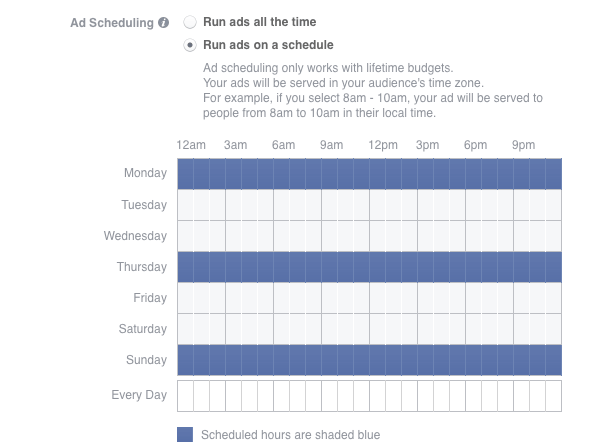
As we know by now, you can set your ads’ schedule of when they are shown. You can choose the time of day, or day of the week, based on your offer and relevancy.
Source: Facebook
Sure, it seems obvious to run your ads during weekends or evenings, where you assume most people might be online. Still, we’ve found the way to create your ad schedule is to analyze your specific customer data (like the stuff you get from Facebook Pixel). Once you’ve done that, it’s essential to look at your ad intent: what am I trying to get them to do? What time of day, or day of the week, are people taking this action?
Combining Google Analytics, Facebook Pixel, and Facebook Analytics, you can determine more than when your audience is online, but when they are taking these specific actions. You can see when they are subscribing or signing up, and when they are buying.
It’s best to analyze this data to create a custom ad schedule, specific to each ad. Now, we know this can seem a bit overwhelming. Check out what happened when we teamed The Maple Guild to implement a Facebook ad strategy that increased their revenue by 300%, and their purchases by 200%.
Take it from us, working with Facebook Ads is a never ending lesson, as there are always ways to improve and optimize your efforts to maximize your results. We’ve run thousands of ad campaigns for all kinds of businesses and have used that expertise to help you save more money on your Facebook ads.
2020 has been a difficult year for most businesses. Consumers have less disposable income due to the impact of the coronavirus and Covid-19 pandemic, which means people are less willing to part with their cash in exchange for non essential, luxury items. The good news? There are still people out there buying and you could make a success of new products that you want to bring onto the market. The difficulty? You’re going to have to work harder than ever to make your sales and generate a profit. But take this as a challenge. You could make a huge success of your business, you just need to make the right decisions and take the right actions. Here are just a few things you need to do to get your new product onto the market as quickly and successfully as possible!
Identifying a Gap in the Market
First, you need to identify a gap in the market for a product that is going to sell right now. See what areas are making profits. See what things people are buying. Consider what things people are going to want to buy in the foreseeable future. Following trends can see you experience success. Being ahead of the curve can see you make even more profits. So, spend time researching and analysing the marketplace before speeding ahead with any decision making.
Product Development and Market Research
Next, you need to develop your product. Look into it. See how you’d make it. Try having a prototype made up with prototyping specialists. Conduct some market research to determine whether people are interested in it and whether people would be willing to spend money on it in the current marketplace. Determine how much people would be willing to spend on it right now and whether there’s room for a good profit margin. This will all help you to determine whether the product is worth bringing to life or not.
Manufacturing
If you get the go ahead, manufacturing will be extremely important. Manufacturing is the process of taking raw materials and putting them together to create your end product. You can do this in-house by investing in all of the machinery and equipment you need to create your products in bulk and by hiring staff to operate the machinery and equipment. Alternatively, you can shift the responsibility to someone else and outsource your manufacturing. You’ll simply put in an order and receive the end product. Both are great options, but the majority of businesses (particularly small businesses) opt for the latter.
As you can see, it is possible to bring new products to the market this year. You just need to put a fair amount of work into determining whether there’s currently a market for your products and whether you can make profits with them in the current economic climate. The above advice and steps should get you started out in the right direction. You never know - you might experience a whole lot of success!
What is your goal in life? Whatever it may be, it will not come in a neat package on your doorstep. You must work hard towards achieving it. You must also be prepared to keep at it for the long-term in a considerable portion of your life. However, this is easier said than done.
It is easy to get distracted from working toward your goals. However, you can maintain your will and stay motivated by adopting a smart plan. Here are five tips to get you started.
Be Realistic
So, what is your goal in life? More importantly, can you achieve it, and how do you picture yourself doing it? Don’t set yourself up for disappointment. Be objective when setting your goals and take into account your strengths and weaknesses. Remember; you will dedicate your life towards achieving these goals, and a mistake at this juncture wastes a lot of your time and energy.
Set Manageable Milestones
It takes time to achieve long-term goals, and they usually add up in small increments over time. For example, a junior-level employee in a multi-billion-dollar company would have to work their way up the ranks to become the CEO.
The problem with focusing on the end-term goal only is that you don’t see the smaller achievements along the way. It also makes you fall out of touch with the master plan. Setting milestones helps to prevent this by making the task feel more manageable. Suddenly, becoming the CEO of a multi-national company doesn’t seem impossible when you start climbing up the ladder, one promotion at a time.
Wouldn’t it be great if you got to the top all on your own? It is possible – it is also rare, and it takes considerable grit and time (and a dash of luck) to do. Many people at the top use some help and guidance along the way to get there. You are not exceptional. As such, surround yourself with people who can help and guide you in your endeavors, and avoid people who may distract you.
Create Accountability
It is easy to slack on achieving your long-term goals when there is no one to hold you accountable. However, you don’t need a second party to hold you accountable – you have your best interests at heart, which puts you in the best position to hold yourself accountable.
It also doesn’t hurt to reward yourself when you inch close to your goals. In fact, it is a good motive to keep going. It is especially motivating if the reward reminds you of your dedication and achievements. A challenge coin is a befitting gift, and you can personalize one at Challenge Coins Ltd to go with each achievement.
Stay on Target
It is impossible to be certain about the future. The best you can do is hope for the best and brace for the worst. However, uncertainty doesn’t mean that you should stop trying to achieve your wildest goals. As such, ignore the distractions and deal with the sideshows, but don’t lose your focus on the end goal.