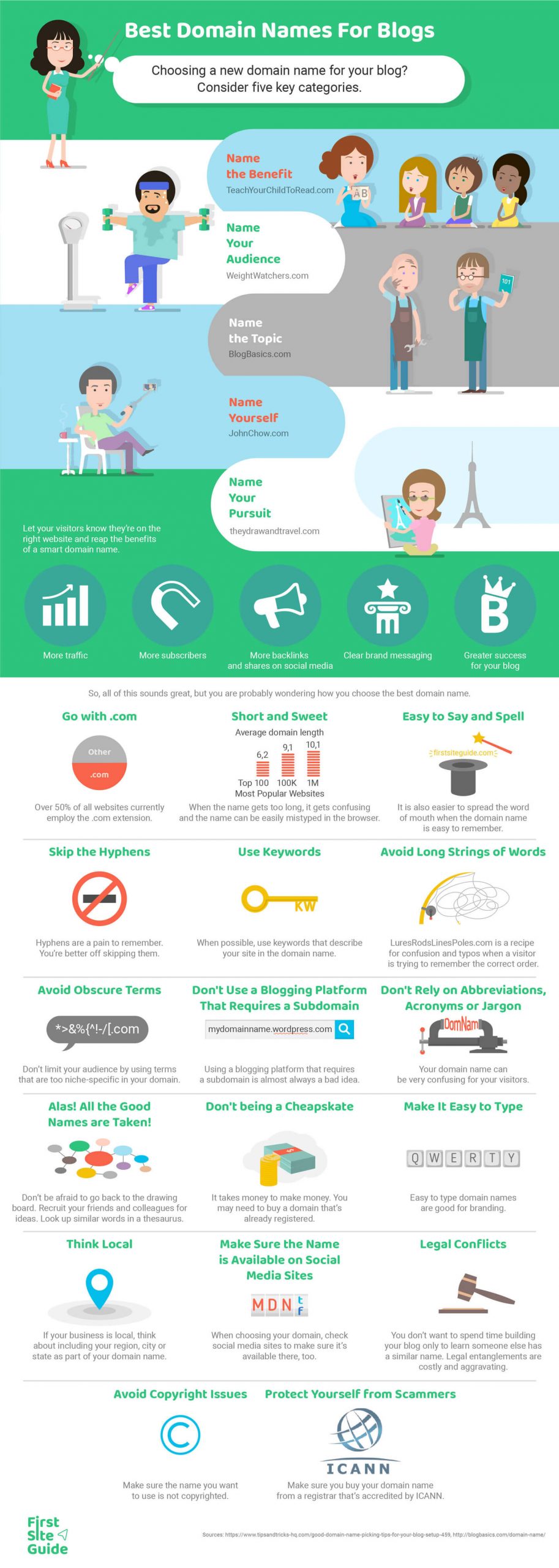
When creating your own website, there is so much that you need to take into account. Are you building this website as a part of your business? Is it a passion project? Are you just wanting a platform where you can post your ideas? Portfolio maybe? Regardless of the reason, you’ll need to know where you’ll want to have your website (such as WordPress), the hosting company, and most importantly your domain. Your domain name is very important because this will be a part of your brand. This domain name will be how you can establish your website, but also yourself online.
When deciding on a domain name you’ll need to do a lot of research. This domain needs to be available online unless you’re willing to pay a hefty amount to purchase someone else’s domain. But your domain name should also be something that is easy to remember and doesn’t come off as spammy.
If you’re interested in having your own website, be sure to take a look at the infographic below. This will help give you an idea of what your name should be as it must tie into your brand. This infographic is a fantastic way to demonstrate how the domain name for the website should be something easy to remember, that sticks to your brand, that’s SEO friendly, and overall just a name that will help you reach the traffic your website deserves. Be sure to check it out below to learn all the ins and outs of choosing a domain name.
Customer engagement is the number one thing your business needs right now; you’ve researched your competitors, you’ve gathered a following on social media, you’ve made your first sale, and now you need to boost your numbers for continued success. To help you do that, we’ve covered a few of the best ways to bring customers to your door, with a smile on their face and something nice to say about your business.
One of the best ways to get customers involved in your company and any marketing campaign you’re putting together is to give them an incentive. Something that’ll both draw them in and ensure they stick around until the end, such as when the new product goes on sale.
And one of the best ways to incentivize an audience is via competitions and giveaways. You’ll see these a lot on social media; a lot of brands like to give people the chance to win by simply tagging two or three friends in the comments under a post. Why not give this a try yourself, and see if your numbers ratchet up?
Personalize Their Experience
Next up is the idea of personalizing a customer’s experience, on a case by case basis. Of course, this is hard to do when approaching your customer base as a whole - even just asking for feedback after a customer service phone call can cause some people to immediately put the phone down!
But if you give them a platform to use, that they can tailor to their own needs, which then feeds information back to you, you’ll be able to meet them more than halfway. One of the best ways to provide this option is via the development of your own app; it’s easier to hire app developers than ever before, if you don’t have your own IT department.
The main benefit here is giving customers a way to customize how you approach them; they can save searches, allowing you to better recommend products to them, and a higher user count is very impressive if you want to attract further investment. This’ll help your app to become better in the future.
Offer Something More
Be sure to offer something unusual or different to your usual service, especially if you already have an established customer base, and you’re looking to capitalize on repeat custom. You need to be able to bring them back, even if you sell ‘one time’ products,
One of the best ways to offer more is via collaborating with other small businesses, both in and out of your niche, to provide product bundles or new features that’ll be very beneficial to the person on the other end. Above all else, you’ll want to work with companies that provide products your customers already want to buy, to ensure the collaboration is worth it.
Customer engagement is a tricky game; make sure you’re playing with the stakes above.
When growing a business, one of the most important considerations that you need to keep in mind is advertising. With no advertising, your business has no hope of gaining any traction or exposure, making it almost impossible to grow your business. Thankfully, there are many marketing agencies that can help you lift your business off the ground and into the limelight.
But is it really worth the investment?
The alternative is to do the marketing yourself. It’s not the most difficult thing in the world, but it’s going to take some serious planning and dedication if you want to make it work. But how worth it is this approach compared to hiring an expert?
In this post, we’ll be taking a look at some of the major differences and reasons why you might want to pick one choice over the other.
Perhaps the biggest draw to hiring a marketing agency is being able to make things a whole lot easier for yourself. Instead of worrying too much about things like how to approach your audience or how to get noticed on social media, you can just focus on growing your business while marketing specialists handle the rest.
Working with a competent advertising agency means that you’ll easily be able to focus on other tasks while your team of experts gets you noticed. Since there are so many decisions and skills needed to market a company, it’s not something that you should be doing without experience. People often say that there’s no such thing as bad publicity, but these days, if you don’t make an impact on social media or create a bad first impression, people will forget about your business and just seek out alternatives that probably already exist.
Agencies also have many different connections to the industry that you want to grow in. This means it’s much easier for those teams to reach out to designers, website developers, and other important team members that will assist your business’s growth. In short, hiring an agency is definitely the way to go if there are lots of other responsibilities that you need to take care of and there aren’t enough people in your company to grow your business.
Doing it yourself gives you a custom approach
One of the biggest benefits of taking a solo approach to marketing is that you’re able to completely define the way that you present yourself. For example, if you choose to use radio advertising to grow your business, then you’re the one that gets on the radio and you become the voice and face of your business.
Putting a face to a brand is an excellent decision if you’re able to spend the time required. If you have other staff members in your company and they’re able to take care of the bulk of the responsibilities for growing your business, then becoming the public face of your brand is never a bad idea and can work out in your favour.
Whether you’re CEO of your own business, beginning your entrepreneurial hustle, or working within a large business, a high productivity drive is what sets apart the winners from the losers. You can have the best ideas in the world, but if you don’t have the motivation or energy to see them through, you’ll be doing the ideas (and yourself) a disservice. So, if you’re looking for productivity tips, then you’ve come to the right place.
1. Plan
To-do lists aren’t going to set the world on fire, but they can seriously increase productivity and keep you organized. It’s recommended to do these the night before or at the end of your working day. Write down what you want to accomplish the next day. If putting pen to paper isn’t your thing, there are loads of online to-do list tools you can use.
2. Get single-tasking
Multitasking is not the way forward - it’s a sure-fire way of getting nothing done quickly. So, pull it back, and focus on one thing at a time. You will immediately notice how much more focused you are. By placing all your focus on one thing, you can get it done quicker and better, and on to the next task.
3. Outsource where necessary
There is no need to bang your head against a wall to complete something that’s outside of your expertise. Boost your productivity by placing your energy where it can make a difference, not where it can’t. For example, if you need a marketing expert then you can call upon Joey Armstrong, and for a project manager, utilize a person or online tools.
4. Take breaks
It could sound counterintuitive, but taking breaks can help your focus. By setting a time to step away from your laptop, breathe, have a cup of coffee, or go for a walk, and see how much better you feel when you get back to work. If you find this difficult, it could be necessary to schedule these in to your day, so you don’t miss them.
5. Notice your patterns
Do you work better in the evening? Or are you a morning person? By understanding your working patterns, you can work with yourself rather than against yourself. If you find you work better at a certain part of the day, you can use these specific times of the day to complete tasks that are particularly taxing. Meaning you always stay on top of your game.
6. Remove distractions
That could mean removing the TV from your eye-line or turning your phone on Do Not Disturb while you’re working. Some people consider using noise-cancelling headphones or dedicated focus music to keep them going. Whatever helps you - make sure to use it every day to keep your productivity levels high.
7. Look after yourself
Ensure you’re getting enough sleep every night to aid your concentration and make sure you’re fuelling yourself properly with good food and proper hydration. These are the bedrock of proper concentration.
One of the biggest challenges for any small business owner is raising awareness of your brand. No matter how good your product or service may be, if you don’t have the customer base then you will struggle to succeed in your endeavors.
There are so many different ways of promoting a business, from social media to word-of-mouth marketing. But one of the methods that tends to be overlooked is radio advertising.
Promoting your business across different radio stations has the potential to reach a huge audience. You can craft your audio advert and target it to your ideal audience to make the desired impact. Unlike many other free forms of marketing, radio advertising does come at a cost. This will vary depending on the radio station used and the length or nature of your advert, but if you do it right, you will see an excellent return on your investment.
To get you started in the world of radio advertising, here are three tips to promote your business from station to station.
Find your demographic
One of the fundamental steps in any marketing strategy is to define your audience. What does your ideal customer look like? Take some time to craft a detailed picture of your target buyer persona, thinking about factors such as age, background, occupation, income, interests, buying habits, goals, and pain points. Using this information, you can then pick the most appropriate radio station to target them. There are countless stations out there with a range of different content from music to news to light entertainment. Each station has a target demographic and you will need to make sure you pick the one that will allow you to reach as many of your target audience as possible.
Reach out to the radio station
The next step in launching a radio advertising campaign is to reach out to the station or stations you have chosen. They will usually be able to provide you with a media package outlining the advertising guidelines, their demographics, and the expected costs for your advert. This will help you craft the perfect advert and finalize your long-term strategy.
Create an advert
Radio adverts are short and to the point, and you will need to get as much information across in as short a time as possible while being entertaining and engaging too. It could be a promotion for a new product or service, or a press release announcing a recent piece of news. One extremely effective way of using radio is to launch a giveaway or competition to win a special prize. Listeners will need to engage with your brand to be in with a chance of winning, either by visiting your website or phoning in. This will get more eyes on your company and potentially a whole host of new customers.
Influencer marketing has gained ground over the past years. Its success is anchored in the widespread use of social media but is made more relevant because people want to find ways to be attached to celebrities and role models they look up to. This sense of attachment and relevance has quickly impacted the value of influencer marketing. According to Forbes, its value reached $8 billion in 2019 and is expected to hit $15 billion by 2022, a figure worth considering. This article will discuss tips to create an effective influencer marketing strategy.
Research
The first step is to find an influencer, and just as with any strategy, research is critical. You need to assess your objectives, tools, and, most importantly, the influencer(s) you want to work with. Websites like unrulyagency.com offer a lot of insight when it comes to research on influencer marketing.
Finding influencers
Mind you, your choice of influencer(s) will determine your success or otherwise of your goals. First, identify where your target audience is online and then create demographics for them. Use the information garnered from those demographics to determine which kind of influencers they will relate to most. You will then have to decide from the pool of influencers you have, based on factors such as cost, willingness to partner, and other influencer engagements. You cannot work with your direct competitors’ influencers as that may be a breach of contract.
Determine your budget
With some information gained from negotiating with influencers and considering other expenses, you should create a budget. You will then use the budget for the running costs of the influencer marketing strategy. Keep in mind that influencer marketing can be quite malleable, so be ready to make changes and adapt. It may affect your budget as well.
Communicate your objectives
The most important aspect of influencer marketing is cultivating a proper working relationship with your influencer(s). If they are in tune with your messages, they will be more likely to help you achieve your objectives much quicker. So, cultivate a healthy relationship with your influencer(s) and communicate your goals to them. This way, they will know how to get the most engagement out of your target audience.
Evaluate and refine your strategy
As mentioned earlier, the field of influencer marketing changes quite often. As such, you need to evaluate and refine your influencer strategy continuously. It works best when you have a healthy relationship with your influencer(s) because they will understand why you need to make any changes or use a different approach to meet an objective.
Influencer marketing is here to stay and has evolved and become a niche of its own. Knowing your audience and using influencer marketing is one way of attaining your organizational goals. Before you begin, be sure to conduct proper research, as it will be the foundation for the entire influencer marketing process. Also, always keep in mind that your influencer(s) choice will directly impact your influencer marketing strategy’s success.